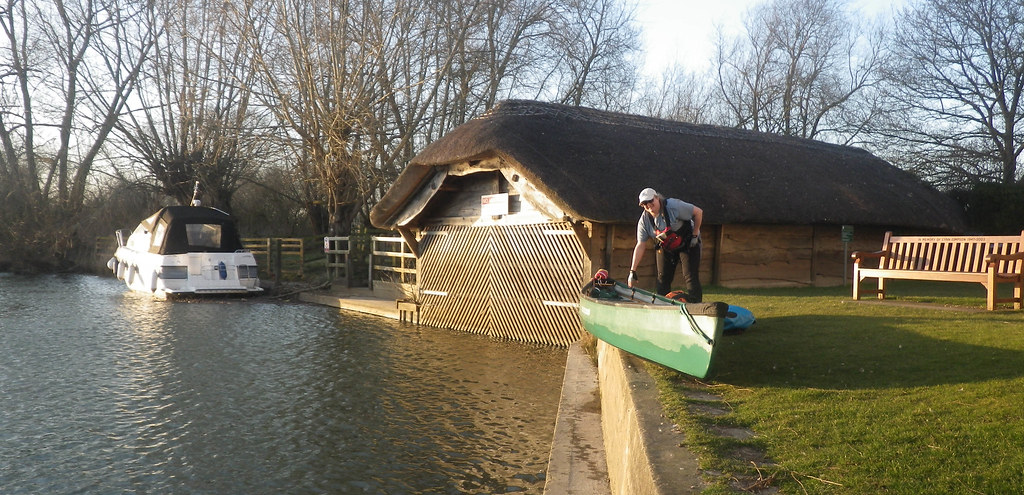
The Song of the Paddle website is a haven for canoeists. We’ve posted our paddling trips there for many years, getting tips, sharing what we’ve learnt.
I posted our most recent trip report in their trip blog section.
The Song of the Paddle website is a haven for canoeists. We’ve posted our paddling trips there for many years, getting tips, sharing what we’ve learnt.
I posted our most recent trip report in their trip blog section.
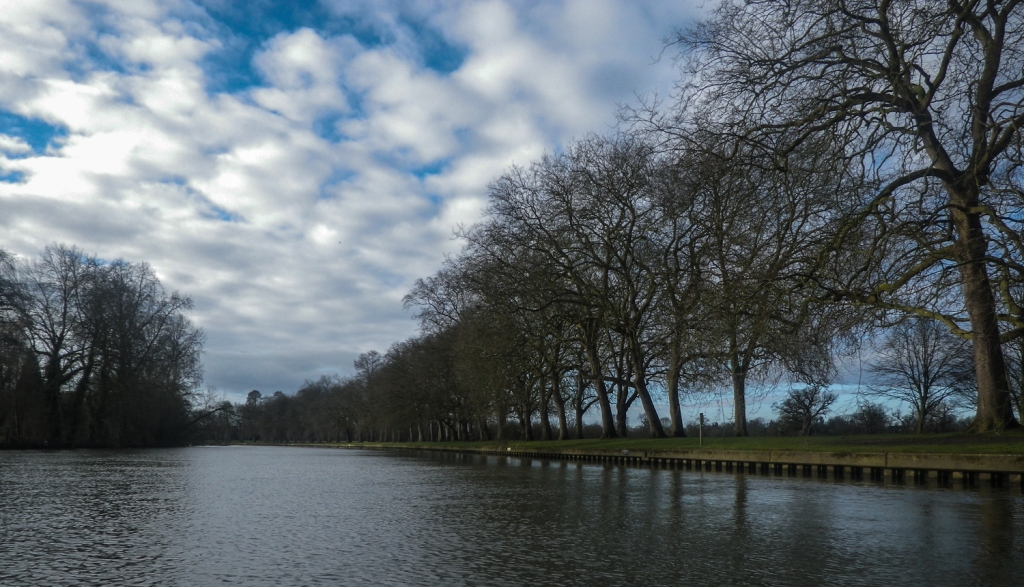
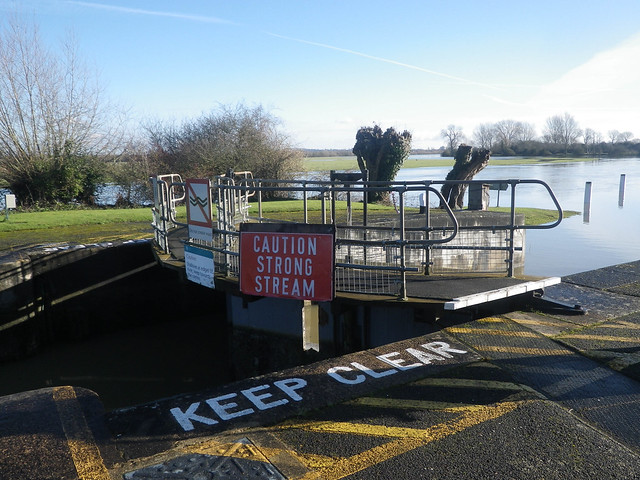
After paddling a couple of rivers with nightmare numbers of portages and really horrible portages I was more persistent about the Thames. The portages aren’t hellish and you may even get to just bimble through a lock.
We planned a route from Datchett to Hampton Court or Kingston – a bit shorter than the days when training in 2013 but we didn’t start those big long ones to March. After suffering from a trapped nerve in my shoulder in the middle of the week, I wasn’t sure how the day would go.
We were on the water at 9.30am. Not many February mornings where you find yourself down to a t-shirt. The weather was good, and we had packed gorgeous pasta for lunch that Dan had cooked up the night before. This was our first time out with both of us using the nifty bent lightweight carbon paddles and its much easier to balance the power when we have the same type of paddle.
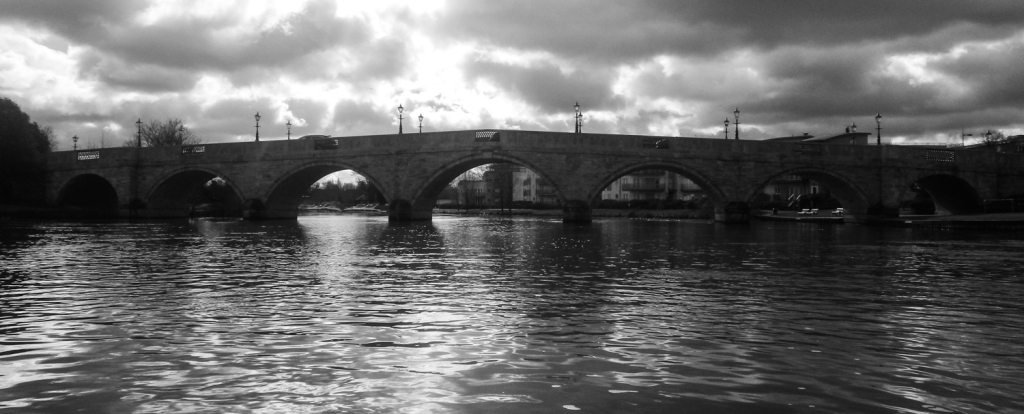
We did the first 5 miles in an hour with aeroplanes taking off and coming into land above although it made conversation a bit tricky – I think I annoyed Dan even more than usual with my requests to repeat himself.
5 miles in we stopped at a lock for coffee. We paddled another 5 miles, where we had the first lunch. As the river gets busier we hope to be eating and drinking in the locks but for the time being this gets done as we portage.
Despite the great weather the river was still quiet although we did have some fun when the odd river cruiser came past making it bumpy. Other than that there were rowers, who seemed to be behaving well and paddling on the right side of the river.
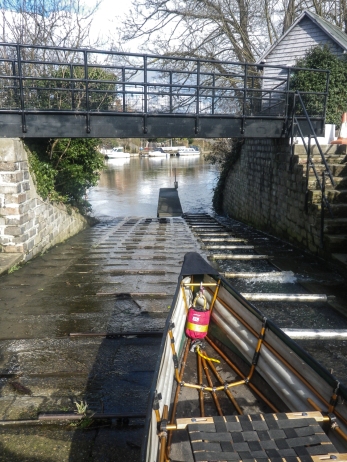 The lock at mile 15 was displaying a notice saying that the next reach was closed for 3 hours. We had planned on 2nd lunch but after a chat with the lock keeper we discovered that this was for a rowing race. They were happy we had time to clear the reach if we left then. So off we paddled. We are pleased to say we were first across the finishing line and then made sure we had 2nd lunch at the next stop.
We soon found ourselves at the ornate gates of Hampton Court. We were definitely not for stopping there and so paddled on to Kingston. We arrived all too soon, 14.30 in fact. High tide at Richmond was 16.16 and so paddling past Teddington, against the tide, wasn’t something we were up for today. The station at Teddington was some way from the take off so this was the sensible take off. We called it a day knowing we could have managed more.
It was a good day with laughter and good tempers and I was feeling very happy that my shoulder had held though it’s still not that happy. Dan did break right at the very the end with some grumpiness about where to get the boat out, but still possibly a world record for him.
Getting home before 5pm gave us plenty of time for packing away and baths before dinner.
We’re launching our fundraising pages today. You can find it over at Virgin Giving. It would be lovely if you would consider passing our site around, and ask if people can spare a little cash for our story.
We want to offer a little something as a little bonus to people that sponsor us. We looked at Kickstarter like models, but charity giving and gift-aid puts the kibosh on most of the fun. However, we have a little something. We’ll be sending out 25 handwritten postcards from the finish line of the race. 10 will be picked randomly from all lovely donors. The others will be sent to the first 15 donations of over 25 quid. When you donate please ensure we can get your email address, or drop us a mail identifying yourself. We’ll ask for addresses nearer the time.
A number of people have asked us if we are being sponsored for our big race. Others, when presented with the plan to use the adventure to raise money, ask if the charity is helping us with travel and training.
They are good questions, and the simple answer is no. There is a far more interesting answer though.
Sarah and I learnt to paddle and then to lead, guide and teach at Shadwell Basin, starting when we joined Tower Hamlets Canoe Club as beginners 8 years ago. Without our time spent there and the commitment from the people we’ve met, we’d not be in the position to be able to do this race. The collective time, effort and focus of people in the club, the staff, committee and students at Shadwell Basin have contributed to the paddlers we are today. It’s not your traditional sponsoring, but far more valuable.
You might start to see why we selected this charity. But it’s more than just a place we know. Shadwell Basin Outdoor Activity Centre is located in an area that has great poverty. They engage with youngsters in the area, using water-sports and other physical activities challenging them to grow in confidence, teamwork, leadership and learning. We are both proud to be part of the committee that helps guide the charity.
Our chosen charity is, in comparison to many, pretty small. They have 5 full-time staff, who all do front-line work as skilled activity leaders, as well as planning, fund-raising and administration. No money we raise will be going back to us in terms of assistance in our adventure. All of it will be for the benefit of the users of the centre.
We aren’t against sponsorship, if you work for a canoe equipment company or somewhere that does something that would help us on our way and would like us to use or try your gear, then we’d love to hear from you, but if you have a little spare cash, please add it towards our charity collecting targets.
Valentine’s day means a special treat. In our case it meant a trip to Reading, to Marsport who are specialists in racing canoeing. We spent a bit of time with Paul, who then sent us off to practice for a few hours.
You see I’ve been doing this canoeing thing for maybe 6 years now which is way long enough to have built up lots of learnings that won’t suit a ultra-marathon style paddle. What might work to get me down a few rapids or an afternoon along a bit of Lake Superior, isn’t going to be what ultra-marathon canoe race needs.
Half a million paddle strokes is what Paul said we were likely to be doing over the 4 days of the race. Put like that, getting each stroke to go gently on our bodies is as important preparation as time planning and distance training.
We started the morning on a canoe ergo. It’s a rowing machine for paddlers. We used to it look at technique – what we do wrong and what we do right. There’s a lot of arm positioning that contributes to the shoulder pain I get when working on the distances. As for Sarah she needs to remember to punch more (the water, not me).

We then moved to paddle circuits on the Thames outside the shop, with a light-weight carbon fibre paddle that’s more suitable than my lovely wooden paddles. Again we got feedback as we went around to try to move to a safer paddling style for long distances.
After an hour Paul felt we were ready to practice what we had learnt, and we borrowed a boat and headed up the Thames. There has been a lot of rain the night before and the Thames was rising, meaning we had a tough paddle up river. We made a good pace and Sarah reported that with the new paddle she needed to steer a lot less and could work less hard in the back.
I worked on my body rotation whilst sitting up (I’m used to kneeling) and trying to get my hands in the right places at the right times. The aches and pains afterwards suggested I’d not got it right. More practice needed. On the other-hand I now have a bargain cosmetic second carbon fibre paddle to train with.
Some stats:
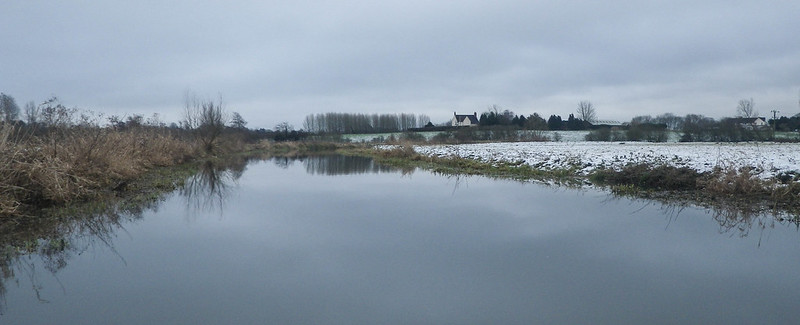
After our twice round Oxford trip it was time to step up the distance. We wanted something travelable to by train as it makes it easier to plan and I don’t have to drive afterwards.
The Cam between Cambridge and Ely was our ideal plan. However the rowers had other ideas. On the day we planned, a big section was being used for a race and others can only use the river under control of race marshalls. Standing on the bank in the cold for an hour wasn’t in the training plan, so we replanned.
We decided to paddle the river Stort to its confluence with the river Lea and then onwards to Cheshunt. We have paddled sections of this but it was time to join it all up. You can see a map of all the obstacles on our route here: http://www.dcbt.org.uk/Documents/LeeStortMap.pdf
We took the train out to Bishops Stortford having packed up as little kit as we could. Getting on and started was easy. It was going well until we hit the ice. We’d got to a stretch where we there was repair works to a lock. The stillness of the water meant that the river had frozen. We bashed through a bit but it was not good for our soft PVC pakboat so it was time for a carry round. I hate boat carrying.

We were finding it tough with the cold and the amount of portages round locks so an extra long carry was not welcome. We kept on, and despite losing time early on, picked up speed. Then it started to snow. Big flakes of snow. It settled on the bags and the bottom of the boat. And us. Brrrrrr.
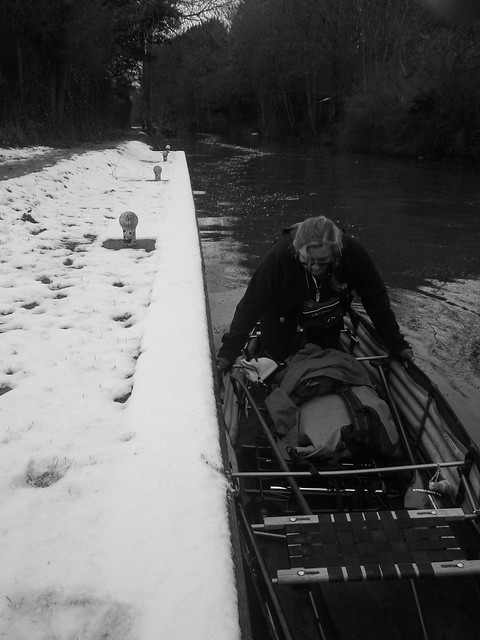
As the snow fell, the reflection on the water made it look as though it was coming down and heading upwards again. It was only going to get stranger. We made the miles pass with an A – Z of what we could have for tea tonight. It got a bit silly towards the end of the alphabet although Dan did need to know that Sag Aloo does not start with a P, even if it is made with potato.
Around the locks we were trying to have very minimal time off the water. We were getting good at the portages until we hit the Lee. The locks on the river Lee have been designed to take industrial traffic and where a lot of the Thames has been adapted to provide lower portage points for canoes and kayaks these are lacking. A lot of standing up in the boat is needed and some of the portages required me to lower myself down into the boat from the bank 4 foot above. I find this really tricky – having had balance issues in the past I find boat to land transfer tricksey. Dan holds onto the boat as I get in and I may have tested his temper a little with my hesitancy and apparent need to tip the boat up. Ho hum, I’m sure the friendly fisherman appreciated my yelling at Dan.
We kept paddling and despite being slowed by tricky portages we were still on time for our get off. We were aiming to be off at 4pm and at 3.50pm we pulled in. The boat was quickly disassembled (without being dried – oops!) and we headed for the train station. A quick change of trousers was in order on the train as mine were soaked and Dan struggled out of his dry suit standing next to the luggage. We were soon home. Paddling close has its benefits.
This paddle was 29 km. Getting on at around 09.35 and off at 15.50 – 6 hours 15 mins. It’s a bit slower than we would have liked, but with no flow, getting stuck in ice and portages to suffer, I think it was still a solid run. Dan had a slightly different point of view
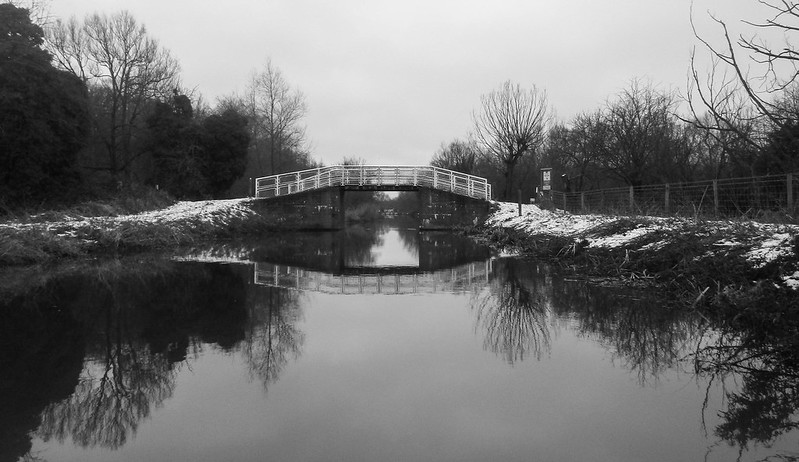
“Paddling was horrific. it snowed for 2 hours, it was so cold the coffee in the flask got chilled, we had 19 locks to carry round, and 1 carry around 200 metres of frozen canal.
 It’s January and Sarah and I are committing to paddling the Yukon together. We’ve drawn out the training plan for the next 2 months and this weekend was our first training paddle proper. A look at how each of us is doing and what we need to learn. We chose the Oxford Circuit cos it’s a looping route that means we don’t have to worry about where to park the car.
We are likely to be doing our training on the River Thames. For most of its length It’s a managed navigation, an adapted river that has locks and weirs to manage the flow. Most of the year it sits at a happy level and boats of all sizes abound. When the river gets fuller and the flows get stronger, yellow boards go up on the locks as a warning. When it’s proper high they put up their red boards and ask people not to use the river unless they know what they are doing.

Dan and I have been arguing together in canoes for around 8 years now and the strength of arguments does seem to be decreasing. It has been over 2 years since Dan last jumped out of the canoe to get away from me.
In 2013 I did the world’s longest annual canoe race, The Yukon River Quest, with Esther. I missed Dan and I spent a lot of time doing things away. I wanted another bash and set about persuading Dan that he too wanted a go at this.
Persuading him to the idea/concept was the easiest part. That we had time to train around work was quite a bit harder. That we could spend that much time in a boat together, without killing each other, was by far the hardest.
We set about doing a few paddles tandem just to see how they went, around Oxford and then on the Wye. Things were looking up. We had progressed from all out rows to stern discussion and only a couple at that. Therefore, at that point the decision was made. On 24 June 2015 we will start the Yukon River Quest, aiming to get 444 miles down the river before the end of 27 June.
This weekend we sat and determined the training plan through to June. Sarah will be losing weight and Dan will be getting strong. We plan to focus on long day paddles with gym training in the week and downtime. The boat is hired, accommodation booked in Whitehorse before the race and now to build a holiday around this silly idea.
We haven’t yet submitted the entry. There are 28 boats entered. Boats no 26 onwards get an extra 1/2 hour in bed on the start day and I am waiting until there are 30 in front to guarantee that in case of drop outs. I think everyone else is waiting for the same thing.
This weekend we are off for a long paddle with as much of the light as we can use. It’ll be Dans first experience of the no stopping for a coffee and eating by throwing a few mouthfuls in every couple of hours. With the forecast for extreme cold we may have to submit to a coffee stop.
There will be all sorts of fun to report as the weeks go by, along with our fundraising attempts for Shadwell Basin Outdoor Activity Centre. As was the case with Barely Scared in 2013 if you have questions, advice or comments please get in touch.
 Paddle faster, I hear an Argument